
Table of Contents
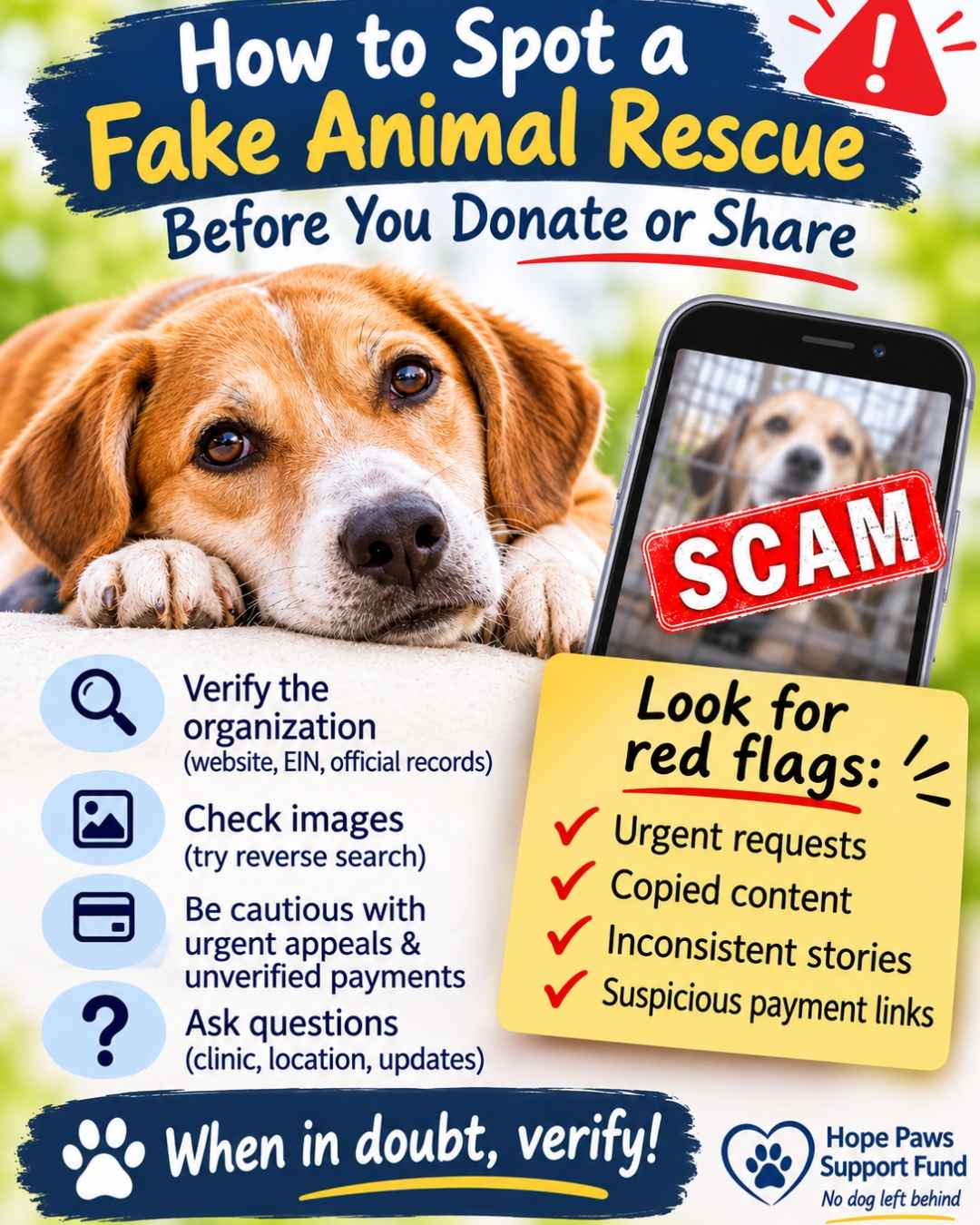
How to Identify Scam Animal Rescues: Before you donate or share an urgent appeal, take a moment to verify the story.
A dog needs emergency surgery. A kitten has supposedly been pulled from a drain. A rescue says it cannot buy food without donations tonight. The photos are heartbreaking, and the page looks convincing—but is the appeal genuine?
Sometimes the emergency is real. Other times, an account uses stolen photos, impersonates a legitimate organization, or shares staged “rescue” videos to collect donations.
The most important habit is verification: check who is asking, whether the animal’s story is authentic, and where your money will go. This guide covers warning signs, practical verification steps, and reverse image searches to help you recognize scams without unfairly judging legitimate rescues.
When Did Fake Animal-Rescue Scams Begin?
There is no single documented starting date for animal-rescue fraud. However, public reporting shows that stolen rescue photos were being used to solicit donations on Facebook by at least 2020. That year, Australia’s Brightside Farm Sanctuary reported that another page had taken its animal photographs, changed the animals’ names, invented stories, and sought “virtual adoption” donations.
Social media expanded the opportunities. A person no longer needed a shelter building—or even an animal—to create a persuasive rescue identity. Stolen photographs, emotional captions, and a payment link could create the appearance of an organization. Reporting from Michigan later documented accounts copying legitimate rescues’ names, logos, photographs, and videos to solicit money.
A related problem is staged rescue content: videos in which animals are intentionally harmed or placed in dangerous situations so a creator can appear to save them. The Social Media Animal Cruelty Coalition, or SMACC, investigated this practice in its 2024 report, Spot the Scam: Unmasking Fake Animal Rescues.
What Do the Statistics Actually Show?
SMACC’s investigation provides a useful snapshot of staged rescue content—not a count of every fraudulent rescue or donation scam.
During a six-week collection period, investigators documented:
| Finding | What it means |
|---|---|
| 1,022 links featuring apparent staged animal-rescue content | This was a research sample, not a worldwide census of scam rescues. |
| More than 572 million views across 605 links with view data | The view total should not be described as money lost or individual victims. |
| 51.9% of collected content hosted on Facebook and Instagram | Meta’s platforms accounted for just over half of the sample. |
| 24.4% on TikTok and 23.1% on YouTube | The problem extended across multiple platforms. |
These figures come from the report’s findings as summarized by participating organization Lady Freethinker. SMACC also reported that 21% of fake-rescue creators asked viewers for donations.
These findings show substantial reach, but they do not establish what percentage of all rescue accounts are fraudulent. A staged-video investigation, an adoption scam, and an impersonation-based donation scam are different categories and should not be counted interchangeably.
Four Types of Rescue-Related Scams
1. Impersonation of a real rescue
A scammer copies a legitimate organization’s name, logo, photographs, or videos, then redirects donations to an unrelated payment account.
This happened to Happy Paws Haven in Michigan. A duplicate Facebook page attracted more than 23,000 followers, reused rescue content, and linked to a different PayPal account. Read more
2. Fabricated rescue stories using stolen content
An account collects photographs or videos from multiple organizations and presents the animals as its own cases.
In reporting by WXYZ, Yaqui Animal Rescue said footage of a neglected dog named Cane had been taken and used by another Instagram account soliciting donations. Read more
3. Staged “rescue” videos
Animals are deliberately placed in dangerous or distressing circumstances so someone can film a dramatic intervention. The content may generate advertising revenue, engagement, or donations.
4. Fake adoption offers
A person advertises an animal they do not have, collects a deposit, and may demand additional payments for transport or other supposed requirements. The FTC advises prospective adopters to meet the animal, check the seller or organization, and avoid payment methods commonly used by scammers.
Major Red Flags—and What to Check Next
A warning sign is a reason to investigate, not automatic proof of fraud. The strongest concern is a pattern of inconsistencies, evasiveness, and unverifiable payment requests.
| Warning sign | What to check |
|---|---|
| The page copies an established rescue’s name, logo, or photographs | Find the organization independently and compare its official contact information and donation links. |
| The donation recipient has an unexplained connection to the rescue | Ask who controls the account and confirm through a contact method found independently. |
| The story changes across posts | Compare the animal’s name, location, injury, dates, and treatment updates. |
| The same photograph appears in unrelated fundraising appeals | Investigate the original context with a reverse image search. |
| The page claims U.S. tax-exempt status but will not provide its legal name or EIN | Check the IRS database and applicable state charity registry. |
| The account repeatedly demands immediate payment | Pause and verify; urgency should not replace evidence. |
| An adopter cannot meet the animal or arrange a credible live viewing | Do not pay simply because photographs look convincing. |
| The page repeatedly posts improbable rescues with nearly identical settings or storylines | Review the pattern for signs of staged content. |
| Questions receive only pressure, threats, or payment instructions | Seek independent confirmation before sending anything. |
These checks address tactics documented by the FTC, SMACC, IRS, and reporting on rescue impersonation.consumer.
Emotional urgency is not evidence
Real veterinary emergencies can require quick decisions. The warning sign is not urgency alone—it is urgency combined with refusal to provide verifiable information.
The fake Happy Paws Haven page claimed animals would be euthanized without immediate donations. Investigators found that it was copying rescue content and directing money elsewhere.
A large following does not establish legitimacy
The Happy Paws Haven impersonation page accumulated more than 23,000 followers. A convincing audience count did not make its donation request authentic.
Repeated dramatic rescues deserve closer examination
SMACC identifies improbable scenarios and repeated settings or narratives as indicators of potentially staged rescues. One unusual video does not establish wrongdoing, but a recurring formula warrants scrutiny.
Real Examples of Reported Rescue Impersonation
Happy Paws Haven: a duplicate Facebook page
In February 2026, WDIV reported that scammers had copied content from Happy Paws Haven, a legitimate foster-based Michigan rescue. The impersonation page used an unrelated PayPal link and falsely presented urgent donation appeals.
Following reporting and complaints, the fake page and associated payment link were taken down. The legitimate rescue was the victim—not the operator—of the scheme.
Friends of Michigan Animals Rescue: a similar Instagram name
WXYZ reported that Friends of Michigan Animals Rescue discovered an Instagram account using its logo and a similar name: friendsofmichiganrescue.
The report also documented allegations that the account used videos from Yaqui Animal Rescue in Texas. The account denied being fake and described itself as a “well wisher” reposting rescue content. This is a documented historical report, not confirmation of the username’s current ownership or status.
Brightside Farm Sanctuary: stolen photographs and invented identities
ABC reported in 2020 that photographs from Brightside Farm Sanctuary had appeared on another Facebook page soliciting donations. Animals were given different names and stories.
The lesson is important: a genuine animal photograph does not establish that the person posting it owns, houses, or treats that animal.
How to Check Whether a Rescue Is Legitimate
1. Ask for its exact legal identity
Request:
- Its legal organization name.
- Its public-facing name, if different.
- Its Employer Identification Number, or EIN, if it claims U.S. nonprofit status.
- Its official website.
- A contact person and independently verifiable contact information.
Search by EIN when possible, because similar organization names can cause confusion. The IRS Tax Exempt Organization Search provides tax-status and filing information. https://apps.irs.gov/app/eos/
2. Verify any claim of tax-exempt status
Use the IRS Tax Exempt Organization Search to review available records, including tax-exempt status, determination letters, Form 990-series filings, and automatic-revocation information.
An IRS listing verifies information about the legal entity. It does not, by itself, establish that a particular Facebook account or payment link belongs to that entity. The Happy Paws Haven case shows why the organization and the account requesting money must be checked separately.
Also distinguish between these questions:
- Does the organization legally exist?
- Is it eligible to receive tax-deductible donations?
- Does this social-media page actually belong to it?
- Is this particular fundraising claim accurate?
One answer cannot substitute for all four.
3. Check state charity records
For organizations fundraising in California, check the California Attorney General’s Registry of Charities and Fundraisers.
Review the organization’s name, registration information, available filings, and status. California registry statuses can include current, delinquent, not registered, or suspended. Read the explanation attached to the status rather than interpreting the label alone.
Registration requirements and exemptions vary. A missing record should prompt further checking, not an immediate public accusation.
4. Review available financial filings
An established organization’s Form 990 can help you understand its activities and finances. However, some smaller organizations file Form 990-N rather than a full Form 990, so a missing detailed return does not automatically establish fraud.
Compare the filings with the rescue’s public claims. If the story does not make sense, ask for an explanation.
5. Confirm the donation channel independently
Do not rely only on the payment link included in the post.
Find the rescue through an independent search, verify its website, and contact it using information you found separately. Ask whether the fundraiser and payment recipient are authorized.
This would have addressed a central feature of the Happy Paws Haven scam: a page that looked familiar but sent donors to a different PayPal account.
6. Ask case-specific questions
For an emergency medical appeal, useful questions include:
- What is the animal’s name and current location?
- Which veterinary practice is treating the animal?
- Is there a written estimate or treatment update?
- Can the rescue authorize the clinic to confirm the case?
- Is direct payment to the clinic possible?
These are verification requests, not guarantees. A clinic may need authorization before discussing a case, and an inability to arrange direct payment does not by itself prove fraud.
For an adoption, arrange an in-person meeting or a credible live video viewing before committing money. The FTC specifically recommends seeing the animal and investigating the person or organization offering it.
How to Do a Reverse Image Search
A reverse image search starts with a photograph rather than words. It can help locate other copies, altered versions, and pages using the same image. Google Lens and TinEye provide image-search tools for this purpose.
Step 1: Save the image or take a screenshot
Choose a clear photograph from the appeal. For a video, pause on a distinctive frame and take a screenshot.
Useful images include:
- The animal’s face and distinctive markings.
- A medical-treatment photograph.
- A recognizable kennel, room, or background.
- The account’s logo or profile photograph.
Crop out unnecessary interface elements so the animal or scene is easier to examine. Keep an uncropped screenshot separately if you may need evidence of the original post.
Step 2: Search with Google Lens
On a computer:
- Open Google and select the camera or Google Lens icon.
- Upload the saved image or paste an image address when that option is available.
- Review matching pages and visually similar images.
- Open the actual source pages rather than relying only on thumbnails.
On a phone:
- Open the Google app.
- Tap the Google Lens camera icon.
- Select the saved photograph or screenshot.
- Adjust the selection around the animal or distinctive detail.
- Review the matching results. The interface may differ between Android and iPhone.
Step 3: Try TinEye
- Open TinEye.
- Upload the image, drag and drop it, or paste the direct image URL.
- Review matching copies.
- Try sorting by “Oldest” or “Most Changed” to investigate earlier indexed copies or edited versions.
An important limitation: TinEye’s “Oldest” means the earliest version TinEye found—not necessarily the first time the photograph was ever published.
Step 4: Compare the stories
For each matching page, check:
- Is the animal given the same name?
- Is the location consistent?
- Does an older post describe the animal as already recovered or adopted?
- Is the same image being used for separate emergencies?
- Does the apparent original organization authorize the fundraiser?
A matching image is a lead, not a verdict. Rescues, fosters, partner organizations, and supporters may legitimately share content.
What the Results Mean
| Result | Appropriate interpretation |
|---|---|
| The photograph appears on a different rescue’s website | Contact that rescue to ask whether the fundraiser is authorized. |
| The same animal appears under different names and contradictory stories | Treat the inconsistency as a serious warning sign. |
| A claimed current emergency uses a much older photograph | Ask for a current explanation and independently verifiable update. |
| An image comes from a stock-photo collection | Check whether it is clearly illustrative or falsely presented as the specific animal needing money. |
| No matches appear | The tool did not find a match; this does not establish authenticity. |
TinEye explicitly explains that no results mean no matches were found in its index. Copies may still exist elsewhere online.
Warning Signs That Are Not Proof of a Scam
Verification should protect animals and donors without unfairly harming legitimate small rescues.
No shelter building
A rescue may operate entirely through foster homes. Happy Paws Haven, for example, is a legitimate foster-based organization without a traditional shelter building.
A private foster address should not have to be published online simply to satisfy strangers. Look for accountable people, credible processes, and independently verifiable relationships instead.
A small following or basic website
Follower counts are not a dependable measure of authenticity. The impersonation page in the Happy Paws Haven case had thousands of followers.
No detailed Form 990
Some eligible small organizations file the shorter Form 990-N. Verify the applicable filing record rather than assuming every nonprofit must publish a full return.
Imperfect writing or an overseas location
Neither establishes fraud. Focus on contradictory claims, stolen identities, unverifiable cases, and unexplained payment destinations—not someone’s accent, grammar, or nationality.
Facebook Groups and Organizations That Raise Awareness
No reliable list can include every useful watchdog account. Groups change names, moderation quality varies, and allegations posted by members may be incomplete or wrong.
The following are research starting points, not endorsements of every post they publish.
Facebook community groups
- Pet Scammers Exposed – Shares warnings about fraudulent pet listings, adoption offers, and payment scams.
- Scam Rescues; Animal Advocacy Community Forum – A community discussing rescue accountability and concerns about potentially fraudulent animal-rescue organizations. Verify supporting evidence before sharing allegations
Instagram Accounts to Follow (must!)
- @wewontbescammed – Raises awareness about fake charities and animal-rescue donation scams.
- @stopfakerescues – Shares evidence-based scam warnings and tips for checking rescue accounts before donating or sharing.
What to Do If You Already Sent Money
Act promptly and preserve the evidence.
- Contact the bank, card issuer, payment service, or fundraising platform you used. Ask what fraud-reporting or dispute options apply.
- Save screenshots of the profile, fundraiser, messages, payment destination, and transaction.
- Record the exact account URL and username—not just its display name.
- Notify the legitimate rescue if its identity or content was copied.
- Report the account and payment destination to the relevant platforms.
- Report suspected fraud to the FTC through ReportFraud.ftc.gov. The FTC directs consumers to report pet-related scams there.
When warning other people, describe the evidence precisely. “This fundraiser used another organization’s photograph, and that organization says it is unauthorized” is more useful than an unsupported accusation.
A Quick Checklist Before You Donate
Before sending money, ask:
- Can I identify the person or organization responsible?
- Have I independently confirmed any nonprofit-status claim?
- Does the social account connect to the real organization?
- Have I checked at least one key photograph?
- Can the animal’s current story be corroborated?
- Have I verified the payment recipient?
- Am I deciding based on evidence rather than pressure?
Compassion should lead to help—not replace verification. Checking a rescue’s identity, story, and payment destination helps protect donors while keeping support available for the legitimate organizations whose animals depend on it.
Sources
- https://www.abc.net.au/news/2020-05-12/animal-rescue-charity-finds-pictures-being-used-to-raise-money/12239660
- https://www.endcrueltyonline.com/fake-rescue-report
- https://www.clickondetroit.com/news/local/2026/02/06/fake-facebook-pages-impersonate-metro-detroit-animal-rescue-threatening-donations/
- https://www.wxyz.com/news/region/wayne-county/fake-animal-rescue-accounts-on-social-media-steal-photos-to-solicit-donations
- https://apps.irs.gov/app/eos/
- https://consumer.ftc.gov/consumer-alerts/2021/11/get-dog-or-cat-instead-scam
- https://help.tineye.com/article/265-tineye-tutorial
- https://reportfraud.ftc.gov/
Leave a Reply